






Watermill Wendland
Conversion of a listed building into living and working spaces
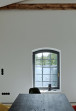
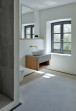
A close friend of mine – a Hamburg-based artist and director – acquired a former watermill from 1881. In an intensive and very personal collaboration, we transformed it into a light-filled place for living and working. The design follows the idea of gentle continuation — building forward with respect for the existing structure and a clear architectural attitude.In the attic, once used for grain storage, an open living floor was created, bringing together kitchen, dining and living spaces.
The historic mill hall beneath it remains largely untouched and now serves as an artist’s studio.
On the ground floor, we reinterpreted the former transmission room — the space where the belt drive, powered by water, once set the millstones in motion. It now functions as a combined library and dining room. The large steel transmission shaft runs through the entire building: from the rear, where the water turbine is located, all the way to the front façade. There, it emerges beside the entrance, carrying a flywheel protected by a small timber enclosure.
The mill’s waterwheel is a horizontal turbine with adjustable blades that can fold flat or stand upright, creating the necessary resistance against the water. The turbine sits roughly four meters below the surface of the millpond, which is held back by a weir.The material palette — wood, steel, concrete and brass — echoes the building’s industrial past and embraces surfaces that age rather than conceal them. The timber floors on the upper levels were preserved, repaired, bleached and treated only with soap. On the ground floor, we uncovered such a mix of old materials that we decided to install a white cement screed with underfloor heating — simply ground and waxed.
The result is a house that preserves the traces of its history while opening the chapter of a new era — a retreat that unites living, working and gathering.
Project Info
Client: Martin Maria Blau
Project: Conversion of a listed watermill
Planning & Realization, LPH 1–8: 2019–2021
FOR SALE
PRESS
HÄUSER 3.2023
A close friend of mine – a Hamburg-based artist and director – acquired a former watermill from 1881. In an intensive and very personal collaboration, we transformed it into a light-filled place for living and working. The design follows the idea of gentle continuation — building forward with respect for the existing structure and a clear architectural attitude.In the attic, once used for grain storage, an open living floor was created, bringing together kitchen, dining and living spaces.
The historic mill hall beneath it remains largely untouched and now serves as an artist’s studio.
On the ground floor, we reinterpreted the former transmission room — the space where the belt drive, powered by water, once set the millstones in motion. It now functions as a combined library and dining room. The large steel transmission shaft runs through the entire building: from the rear, where the water turbine is located, all the way to the front façade. There, it emerges beside the entrance, carrying a flywheel protected by a small timber enclosure.
The mill’s waterwheel is a horizontal turbine with adjustable blades that can fold flat or stand upright, creating the necessary resistance against the water. The turbine sits roughly four meters below the surface of the millpond, which is held back by a weir.The material palette — wood, steel, concrete and brass — echoes the building’s industrial past and embraces surfaces that age rather than conceal them. The timber floors on the upper levels were preserved, repaired, bleached and treated only with soap. On the ground floor, we uncovered such a mix of old materials that we decided to install a white cement screed with underfloor heating — simply ground and waxed.
The result is a house that preserves the traces of its history while opening the chapter of a new era — a retreat that unites living, working and gathering.
Project Info
Client: Martin Maria Blau
Project: Conversion of a listed watermill
Planning & Realization, LPH 1–8: 2019–2021
FOR SALE
PRESS
HÄUSER 3.2023